
Rome does not hide its age. It leaves broken columns beside traffic lights, temple walls inside churches, and imperial roads under modern shoes. A walk through the city can feel like reading a history book with the pages scattered across neighbourhoods.
The best way to understand ancient Rome is not to rush from monument to monument. It is to follow the stories: how a small settlement on hills became a republic, how the republic became an empire, and how daily life carried on beneath all that power.
This guide traces a route through Rome’s most iconic ancient sites, with the history that makes each one more than a photo stop.
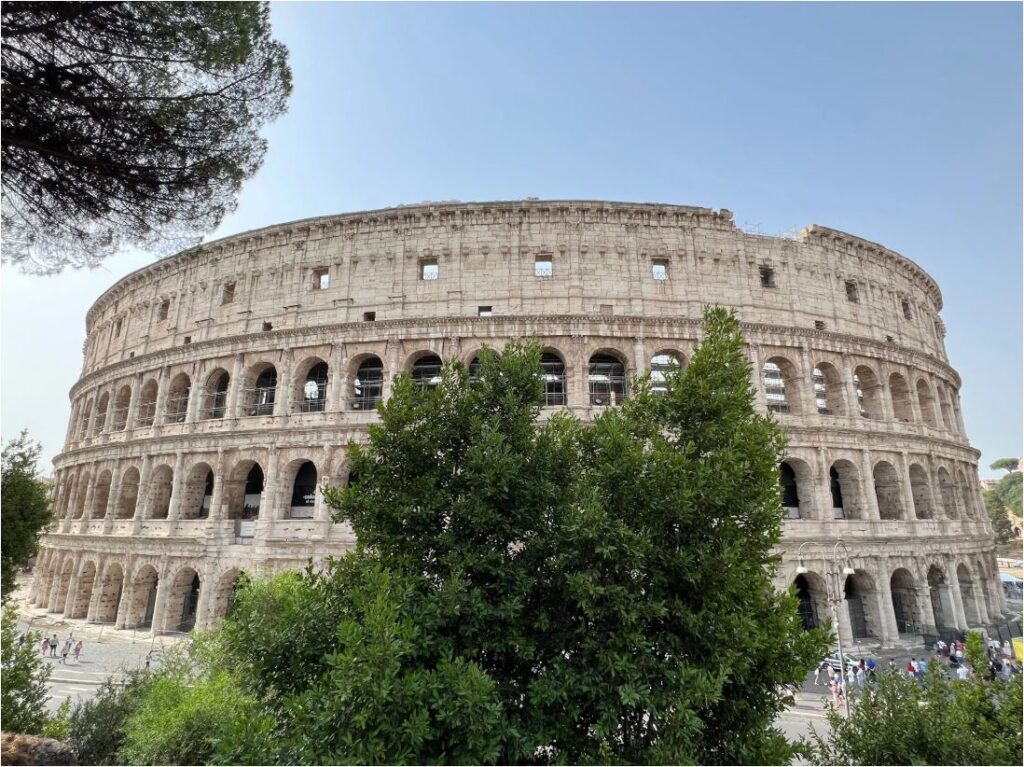
The Colosseum still defines the scale and ambition of ancient Rome.
Begin with the Colosseum and the theatre of power
The Colosseum is the obvious starting point, and it earns that place. Built under the Flavian emperors and opened in AD 80, it was not just an arena. It was a political stage where rulers showed wealth, control, and generosity.
Games here could include gladiator fights, animal hunts, executions, and staged battles. The spectacle was brutal, but it was also organised with great skill. People entered through numbered arches, moved through corridors, and found seats according to social rank. The building could handle huge crowds because Roman engineers understood movement, pressure, and public order.
Look closely at the structure. The outer wall rises in layered arches, with different classical orders stacked above one another. Inside, the missing arena floor reveals the underground passages known as the hypogeum. This maze of corridors, lifts, cages, and holding rooms helped create the sudden appearances that thrilled the crowd.
The Colosseum also tells a quieter story. Much of its stone was later reused in other buildings. Earthquakes damaged it. Plants grew through its cracks. For centuries, it shifted from arena to quarry, shrine, landmark, and symbol. Its survival is not neat, and that is part of its power.
Best way to see it: arrive early if possible, then spend time looking at both the seating levels and the underground remains. The drama of the place makes more sense when you imagine the crowd as much as the combat.
Walk through the Roman Forum where public life unfolded
A short walk from the Colosseum leads to the Roman Forum, the political and religious heart of ancient Rome. At first glance, the Forum can feel like a field of ruins. With context, it becomes one of the most meaningful places in Europe.
This was where senators argued, priests processed, merchants traded, citizens gathered, and victorious generals paraded. Temples, law courts, basilicas, arches, and public platforms stood close together. The Forum was not designed as a tidy museum. It grew over centuries, layer by layer, as Rome’s ambitions grew.
Several places deserve a slower look.
The Temple of Saturn carries the memory of the republic
The remaining columns of the Temple of Saturn stand near the base of the Capitoline Hill. The temple was one of the oldest and most important in the Forum. It also housed the state treasury for long periods.
Its location matters. Money, religion, and government sat close together in Roman public life. The republic was not secular in the modern sense. Political acts often had ritual weight, and religious offices could be stepping stones to public power.
The Arch of Septimius Severus shows history written in stone
The triumphal arch at the Forum’s western end celebrated Emperor Septimius Severus and his sons. Reliefs on the arch show military victories and imperial ceremony. Like many monuments, it was designed to shape memory.
Roman rulers understood public space. An arch did not only commemorate success. It told everyone who passed beneath it who held power, who had won, and whose version of events would be carved into the city.
The site linked to Julius Caesar still draws attention
Near the Forum’s centre, visitors often pause at the Temple of Divus Julius. It marks the area associated with Caesar’s cremation after his assassination in 44 BCE. Caesar’s death did not restore the old republic. Instead, it helped clear the path for Augustus and the imperial system.
That tension makes the Forum especially moving. You can stand among republican institutions while seeing the shadows of empire rising around them.
Climb the Palatine Hill to find Rome’s origin story
The Palatine Hill rises above the Forum and offers one of the best views in the ancient city. It is also tied to Rome’s foundation myth. According to tradition, Romulus founded the city in 753 BCE after conflict with his twin brother Remus.
Myth and archaeology do not always line up cleanly, but the Palatine has clear importance. People lived on this hill in very early periods, and later Romans treated it as a place of deep origin. Over time, the hill became a prestigious address for the elite.
By the imperial age, the Palatine was the home of emperors. The word “palace” itself comes from Palatine. Ruins of grand residences still stretch across the hill, including parts of palatial complexes linked to emperors such as Augustus and Domitian.
The shift is striking. The hill moves from legendary huts to imperial homes, from a foundation story to imperial luxury. Few places show Rome’s transformation so clearly.
Do not rush this section. The Palatine rewards slow wandering. Gardens, brick walls, fragments of fresco, and open views help balance the intensity of the Forum below.
Visit the Pantheon to see ancient engineering at its most elegant
The Pantheon feels different from many ruins because it is still whole enough to enclose you. Step inside and the city noise fades. The great dome rises overhead, and the oculus opens the building to the sky.
The present structure is usually associated with Emperor Hadrian, though its inscription refers to Marcus Agrippa, who built an earlier temple on the site. That layered identity suits Rome well. Buildings here often keep older names, older materials, and older memories even when rebuilt.
The Pantheon’s dome remains one of the great achievements of Roman engineering. The oculus at the centre reduces weight and brings in light. The concrete changes in composition as it rises, becoming lighter toward the top. The result is both practical and beautiful.
The building was later converted into a church, which helped preserve it. That change also explains why the Pantheon feels less like a ruin and more like a living space. It bridges pagan Rome, Christian Rome, and modern Rome without needing to announce the transition.
Pause in the centre and look up. The Pantheon is not impressive because it is large alone. It is impressive because its space feels calm, balanced, and exact.
Stand at the Circus Maximus and imagine the roar
Today, the Circus Maximus is a long open valley between the Palatine and Aventine hills. It takes imagination to see what once stood here, but the scale is still clear.
This was Rome’s great chariot racing venue. Races drew enormous crowds, and the rival teams had passionate supporters. The sport mixed danger, speed, money, and identity. For many Romans, the racing factions mattered as much as the athletes themselves.
The Circus also shows how public entertainment shaped urban life. The Colosseum may dominate modern attention, but chariot racing was one of ancient Rome’s most popular spectacles. The long track, central barrier, turning posts, and seating areas formed a world of noise and risk.
From the Circus Maximus, look back toward the Palatine. The emperors could watch the races from above, linking imperial presence with mass entertainment. Power in Rome was never far from performance.
Explore the Baths of Caracalla to understand daily grandeur
The Baths of Caracalla reveal another side of ancient Rome. Built in the early 3rd century CE, they were not simply places to wash. They were social centres with hot rooms, cold rooms, exercise areas, gardens, libraries, and spaces for conversation.
The ruins are massive. Even without their marble, mosaics, and water systems fully intact, they show how ambitious Roman public building could be. Bathing was part of civic life, and emperors used public works to gain favour.
The engineering behind the baths was complex. Aqueducts supplied water. Furnaces heated rooms and floors. Workers kept the system running behind the scenes. What visitors enjoyed as leisure depended on labour, planning, and fuel.
The Baths of Caracalla are especially useful for understanding scale. Rome was not only temples and triumphs. It was infrastructure, routine, and shared spaces. Ancient life had comfort for some, hardship for many, and systems large enough to organise both.
Follow the Appian Way beyond the city walls
The Via Appia, or Appian Way, is one of Rome’s great ancient roads. Begun in 312 BCE, it connected Rome to southern Italy and became a model of Roman road building.
Walking along its surviving stretches gives a different feeling from visiting the Forum or Colosseum. The road points outward. It reminds you that Rome’s power depended on movement: soldiers, merchants, officials, messages, supplies, and enslaved people all travelled along routes like this.
Ancient tombs line parts of the road because Roman burial usually took place outside the city walls. These monuments turned the roadside into a corridor of memory. Families displayed status, grief, and identity to everyone who passed.
The Appian Way also connects to early Christian history through nearby catacombs, though the road itself is older than Christianity in Rome. That overlap makes the area rich, but it is best understood in layers rather than as one single story.
Best way to experience it: allow enough time to walk rather than only stop for a quick look. The stones, walls, pines, and tombs create a slower kind of history.
Add lesser-known ancient stops if time allows
Rome’s famous sites are famous for good reason, but smaller places often sharpen the larger story.
Largo di Torre Argentina reveals the layers beneath daily streets
This archaeological area contains the remains of several republican temples. It is also near the place traditionally associated with Julius Caesar’s assassination, though the exact ancient setting was part of a larger complex.
What makes the site memorable is its position below modern street level. Cars, buses, and pedestrians move around a sunken field of ancient stone. It shows how Rome keeps building on top of itself.
The Theatre of Marcellus shows how old structures gain new lives
The Theatre of Marcellus looks at first like a cousin of the Colosseum, though it is older and served a different purpose. It hosted performances rather than gladiatorial games. Later, parts of it were absorbed into medieval and Renaissance buildings.
This is one of Rome’s clearest examples of reuse. Ancient arches became foundations for later homes. The result is not a frozen ruin, but a building with several lives visible at once.
The Ara Pacis presents Augustus as a maker of peace
The Ara Pacis, or Altar of Peace, belongs to the age of Augustus. Its carved panels show processions, symbols of fertility, and the political language of renewal.
Augustus was skilled at presenting his rule as restoration rather than domination. The altar helps explain how art supported that message. After civil war, peace became one of the most powerful ideas an emperor could claim.
A practical route for one or two days
A good ancient Rome route balances geography with energy. The sites are close in places, but the heat, crowds, stone paths, and security lines can make the day feel longer than it looks on a map.
For a one-day ancient Rome route, focus on:
- Colosseum
- Roman Forum
- Palatine Hill
- Pantheon
- Largo di Torre Argentina or Theatre of Marcellus
This route gives a strong arc from spectacle to government, imperial residence, sacred architecture, and layered city life.
For a two-day route, slow down and add:
- Baths of Caracalla
- Circus Maximus
- Appian Way
- Ara Pacis
- Capitoline area viewpoints
The second day adds space, quiet, and context. It also helps avoid turning history into a checklist.
A few simple habits improve the experience:
- Read a little before each stop. Even five minutes of context changes what you notice.
- Look for materials. Brick, marble, concrete, and reused stone tell stories of wealth, repair, and survival.
- Notice height changes. Modern Rome often sits higher than ancient Rome because centuries of building raised the ground level.
- Leave room for wandering. Some of the best moments come from turning a corner and finding an old wall no guidebook made famous.
The Appian Way shows Rome as a city connected to a much wider world.
The real reward is seeing Rome in layers
The ancient sites of Rome are not isolated monuments. They speak to one another. The Colosseum explains spectacle. The Forum explains public power. The Palatine explains origin and status. The Pantheon explains engineering and sacred space. The Appian Way explains expansion.
Together, they show a city that changed constantly while keeping pieces of its past in view. That is what makes Rome so rewarding for history lovers. You are not only seeing what remains. You are learning how memory, power, faith, and daily life shaped the city across centuries.
Take the tour slowly. Stand still often. Let the ruins look incomplete at first, then let the stories fill them in. Rome’s ancient sites do not need to be perfect to feel alive. They need attention, and they repay it at every step.